

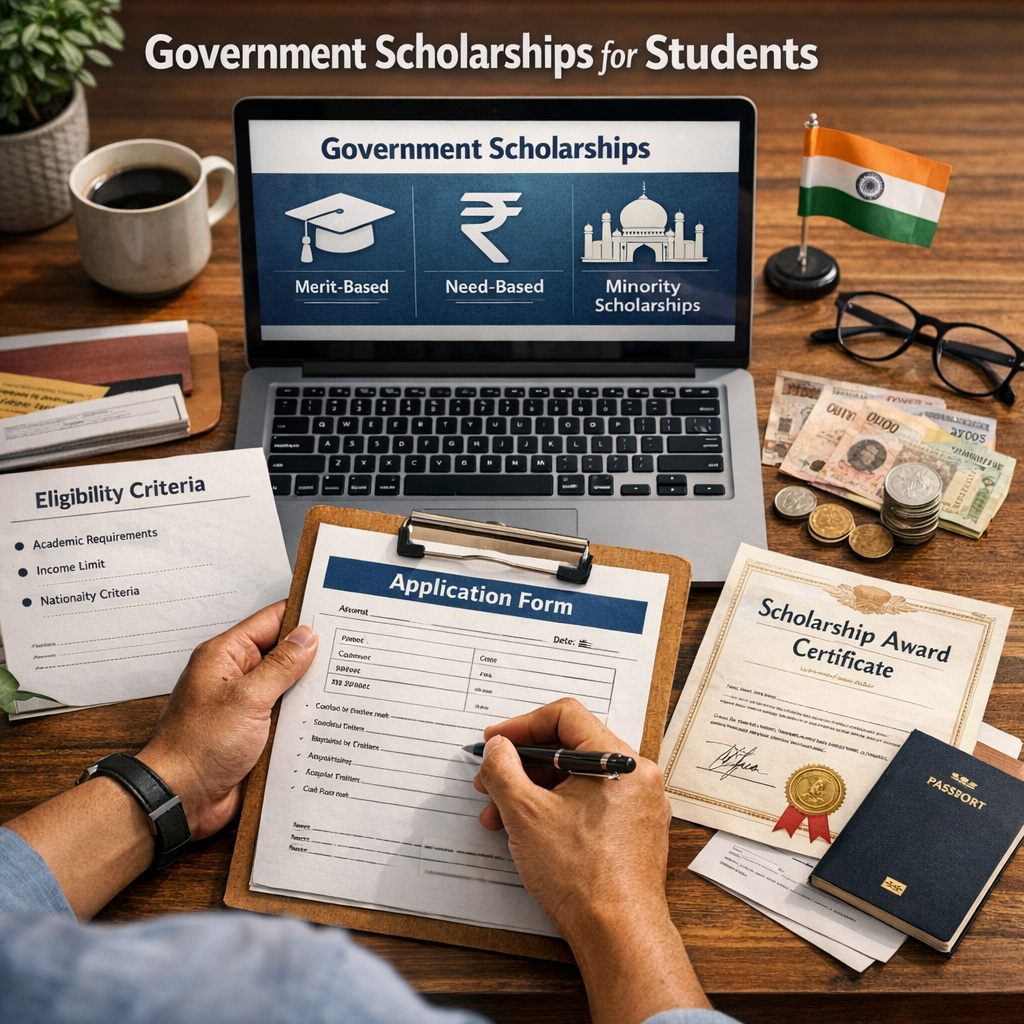
A curated list of government scholarships for students.
Government Scholarships for Students: Key Schemes to Apply for & Steps to Verify Eligibility
A curated news-style roundup of major government scholarships, what they cover, and how to apply safely.
Government scholarships remain one of the most practical ways for students in India to reduce education costs—from school-level support to higher-education funding. But scholarship rules, portals, and deadlines vary by scheme and state.
This roundup highlights commonly used government scholarship routes, who they typically help, and the steps students should take to verify the latest eligibility and application timelines from official portals.
“Scholarships aren’t only about eligibility—they’re also about accuracy, documents, and timing.”
Full Story: Scholarships Are Available—But the Right Portal Matters
Scholarships in India are not issued from a single “one-stop” website for all students. Instead, funding support usually comes through:
- Central government schemes (run by ministries, often through UGC/AICTE or national portals)
- State government scholarship schemes (through state scholarship portals)
- Institute/university-level scholarships (sometimes linked to central schemes)
In practice, students miss opportunities not because they’re ineligible, but because they:
- apply on the wrong portal,
- miss a date,
- upload documents that don’t match requirements, or
- rely on unverified posts.
Why This Matters for Students and Parents
With tuition fees, coaching costs, exam fees, and living expenses, student funding can directly affect whether a learner can continue education. Scholarships can also reduce the financial stress that leads to dropouts.
For competitive exam aspirants (CUET/NEET/JEE track, or later recruitment/exam prep), scholarship support can help in two ways:
- Education continuity (school/college funding)
- Lower out-of-pocket expenses that otherwise compete with exam preparation budgets
Competitive exam aspirants may also benefit from focused study plans; see our 30-day Active Recall routine for a practical study plan: Active Recall 30-Day Plan
Who Is Affected?
These schemes typically target:
- Students from economically weaker backgrounds
- Learners belonging to SC/ST/OBC/Minority communities (depending on the scheme)
- Students with disabilities
- Students pursuing technical education or higher studies
- Students studying in government-recognised institutions
- Students whose parents/guardians meet income and category conditions (scheme-dependent)
Key Government Scholarship Routes (What Students Commonly Apply For)
Below is a curated list of government scholarship routes that many Indian students use. Since scholarship names and exact eligibility may differ, treat this as a starting map—and confirm details on official websites.
1) National Scholarship Portal (NSP): Where Many Central/State Applications Start
If you’ve ever searched “government scholarship apply online,” you’ve likely heard of the National Scholarship Portal (NSP). NSP often acts as a common platform for multiple scholarships.
Typical use:
- Students check eligibility
- Fill application details
- Upload documents
- Submit before the scheme deadline
What students should do:
- Create/confirm account details carefully (name, DOB, category, bank account info)
- Keep scanned documents ready
2) UGC Scholarships (Higher Education Focus)
The UGC (University Grants Commission) is a key authority for scholarship-related funding in higher education. Many scholarship supports for undergraduate/postgraduate or specific categories are routed through UGC-linked processes.
Who it generally helps:
- Students in higher education (UG/PG and eligible categories)
What to verify on UGC/partner portals:
- Course eligibility (UG/PG/PhD, discipline requirements)
- Category and income conditions
- Domicile/state applicability
3) AICTE Scholarships (Technical & Management Education)
If you’re in AICTE-recognised technical institutions (engineering, management, polytechnic, etc.), AICTE becomes important for scholarship-related opportunities.
Who it generally helps:
- Students pursuing technical education in eligible institutions
What to verify:
- Whether your college is eligible/registered
- The correct application channel for your scheme
- Document list and annual income criteria
4) Ministry/Department Schemes for Specific Backgrounds
Across different ministries and departments, scholarships can be targeted to:
- SC/ST categories
- OBC and other notified categories
- Minority communities
- Students with disabilities
Why you need to verify:
- Scheme scope and eligibility differ year to year
- Some scholarships require specific certificates or proof formats
5) State Scholarship Portals (Often Crucial for School & College Students)
Most states run their own scholarship systems for residents/students studying within the state (or sometimes for domicile students).
What students should do:
- Identify your state portal (e.g., via NSP links or state education department site)
- Check the scholarship list by class/stream/category
- Follow state-specific instructions for document submission
Important Dates & Application Timeline (How to Track Correctly)
Because deadlines vary by scheme and state, the most reliable method is to track official notifications:
- NSP portal notifications (for schemes hosted/linked there)
- UGC/AICTE official pages (for higher education routes)
- State scholarship portal homepage
Practical timeline you can follow (safe approach)
- Week 1: Collect documents + check eligibility on official site
- Week 2: Start form filling; double-check bank account details
- Week 3: Upload documents in correct format
- Final days: Submit well before the deadline and save the application reference
If a portal allows “edit,” do it early—last-minute changes can cause rejection if documents no longer match.
Impact On Students: What Happens After You Apply?
Once submitted, scholarship processing usually involves:
- application scrutiny
- verification by institute/state/department authorities
- possible corrections or document re-upload request
Common outcomes
- Approved and disbursed (as per scheme schedule)
- Pending verification (wait for institute/state checks)
- Rejected/asked to resubmit (often due to mismatched documents or incorrect details)
What Students Should Do Next (Action Points)
Step 1: Verify the right scheme using official sources
- Use the official portal links listed in references
- Avoid screenshots of WhatsApp posts claiming “last date extended”
Step 2: Prepare a “scholarship document kit”
Keep scanned copies ready (size/format as required):
- Aadhaar (or as permitted)
- Income certificate (if applicable)
- Caste/category certificate (if applicable)
- Disability certificate (if applicable)
- Previous marksheets
- Bank account details (passbook/bank statement proof if required)
- Passport photo (as per size specs)
If you need to download board marksheets quickly, our guide to checking CBSE Class 12 results on DigiLocker may help: CBSE Class 12 DigiLocker Guide
Step 3: Check eligibility before spending time on the form
- course/class level
- institute recognition
- category and income brackets
- domicile/state eligibility (where applicable)
Step 4: Maintain application proof
- save acknowledgement/reference number
- note submission date
- keep copies of uploaded documents
Step 5: Set a reminder for follow-ups
- Even if you submit early, verification can take time. Set a calendar reminder for:
- status checks (as per portal timeline)
- any correction window
Student Scenario: How Most Applications Go Wrong
Scenario: A student from a state where scholarships are portal-managed submits a form late. The portal shows “submitted,” but later the student gets a request because the uploaded income certificate doesn’t match the required format or the bank details are incorrect.
Fix approach:
- Re-check official document format requirements
- Correct bank details (as allowed)
- Upload the correct certificate during the correction window
This is why the safest approach is to submit early and keep documents aligned with official specs.
Safety Checklist: Avoid Misinformation and Rejections
- ✅ Apply only through official portal URLs
- ✅ Don’t trust “deadline” claims without checking official notices
- ✅ Cross-check your name/DOB/category with Aadhaar and certificates
- ✅ Use the same mobile number/email across applications (where applicable)
- ✅ Upload clear scans; blurry documents can lead to rejection
References (Official Portals to Verify)
- National Scholarship Portal (NSP)
- UGC Official Website
- AICTE Official Website
- Education Ministry / Govt Education Links (start point)
Scholarships Government Schemes Student Funding UGC AICTE