

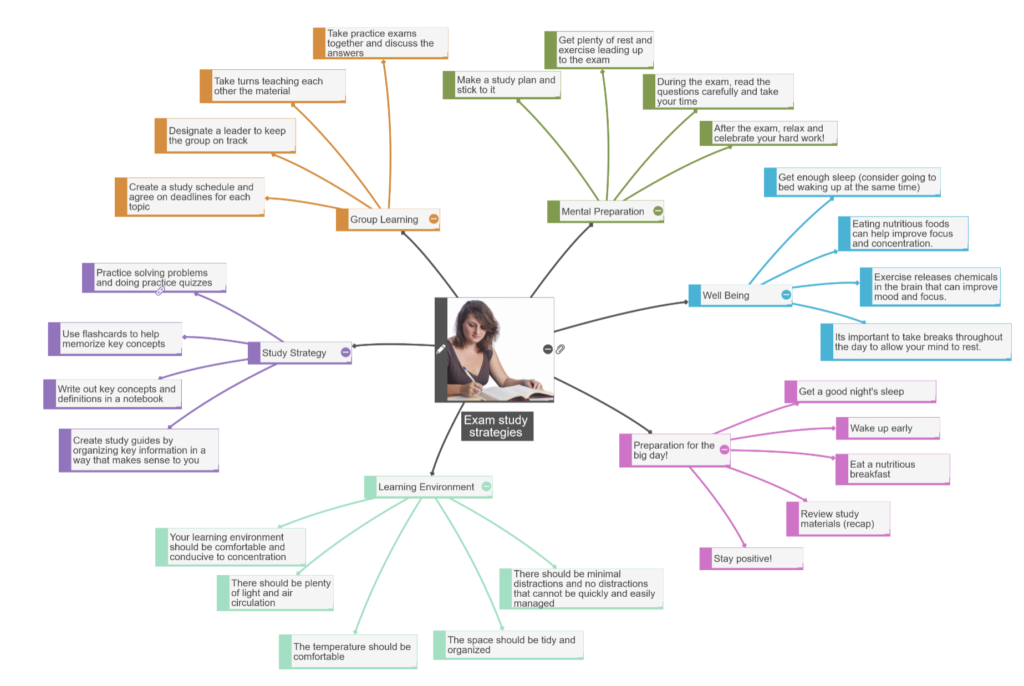
Learn how to use mind mapping as a powerful visual study tool to enhance your exam performance. Discover techniques to organize information and improve retention through creative mapping.
Enhancing Your Exam Performance with Mind Mapping: A Visual Study Approach
Estimated reading time: 6 minutes
Are you tired of feeling overwhelmed by your study materials as exams approach? Mind mapping could be the solution you need to boost your retention and improve your exam performance. This blog explores how visual study techniques, specifically mind mapping, can transform your revision strategy.
Unlock Your Potential with Creative Mapping Techniques
Mind mapping is not just a trendy educational tool; it is backed by cognitive science. This technique allows students to break down complex information into digestible, visual formats, enabling better understanding and recall. In today's fast-paced academic environment, effective study methods are essential for success, particularly when dealing with extensive syllabi.
The ability to engage visually with material means that students can see connections between concepts at a glance. Instead of cramming facts into memory, mind mapping encourages meaningful learning—allowing students to reorganize information creatively and with intent.
Relevance: Learn more about how visualization techniques can enhance your academic performance by visiting Visualization Techniques for Academic Achievement.
Real-Life Success Story
Consider the case of Emma, a university student struggling with Biology. During her first semester, Emma found herself drowning in dense textbooks and lecture notes. After attending a workshop on mind mapping, she decided to give it a try.
Emma created a mind map for her final exam by writing the central topic "Cell Biology" in the middle of a page and branching out with key concepts such as cellular respiration, mitosis, and genetic variation. By visually organizing her study notes, she reported feeling less anxious and more in control. The result? Emma not only passed her exam with flying colors but also found that she could recall the material far better than in her previous study sessions.
Benefits of Mind Mapping
- Improves Recall: By visually representing information, you are more likely to remember it during exams.
- Organizes Thoughts: Mind maps help to clarify and condense information, making study sessions more efficient.
- Encourages Creativity: Students can personalize their maps, adding colors, symbols, and images, which can enhance engagement.
- Facilitates Problem-Solving: Visualizing relationships between ideas can help students approach complex problems more effectively.
Relevance: Enhance your focus and study techniques by exploring Mastering the Art of Focus & Strategies.
Drawbacks to Consider
While mind mapping is undoubtedly useful, it may not suit every learning style. Some students may find it challenging to adapt to such a visual method if they are accustomed to linear note-taking. Moreover, excessive decoration or complexity in maps can lead to confusion rather than clarity. It’s essential to strike a balance between creativity and coherence to make the most out of mind mapping.
Implications & Tips for Students
- Start Simple: Begin with basic concepts and gradually add detail. Don't overwhelm yourself with complexity.
- Use Colors and Images: Incorporate different colors to signify relationships, and don’t shy away from including visuals or icons to enhance memory.
- Review Regularly: Schedule time to revisit your mind maps leading up to exams. Regular exposure will reinforce memory.
- Experiment: Find the mind mapping software or tools that work best for you, or stick to pen and paper if that suits your style better.
- Group Study: Pair up with classmates to create mind maps together. Sharing different perspectives can deepen understanding.
Relevance: For more effective note-taking strategies, visit Effective Note-Taking Strategies.
“Great minds map alike.”
Unlock your full academic potential by integrating mind mapping into your study routine. Visual approaches can turn an overwhelming amount of information into manageable, memory-friendly formats.
References & Links
- How to Use Mind Maps for Better Learning
- The Science Behind Mind Mapping
- Mind Mapping Study Techniques